
Marshall County Criminal Docket Searches
For a felony, district misdemeanor, or county traffic case, go straight to Kansas CaseSearch. A complete case number pulls the cleanest hit. Missing the number? A name, citation number, filing range, current status, or judicial officer can narrow things down. Click Additional Search Filters and select Marshall County. The live Case Type menu changes. Pick whatever option the portal shows today rather than trusting an old list. Legacy addresses still float around in older links. The current state entry point is the safer bet. Whatever the portal returns is public case information, not a certified file. Work in this order:
- Read the citation or notice and confirm that it names Marshall County District Court, not a city municipal court.
- Enter the complete case number or party name, then select Marshall County as the location.
- Use criminal case type, filing dates, status, or citation number only as needed to narrow the result.
- Complete the portal terms and human check, open the matching case, and verify the header before reading events.
- Call or write the district clerk when a public event or document is not available online.
Marshall Criminal Case Numbers
Cases filed in Marshall County after July 11, 2022 carry the Enterprise Justice Odyssey county-prefixed pattern. Consider the synthetic example MS-2025-CR-000001. Here MS is the county abbreviation. The next part is the filing year. CR marks the criminal case type, and six digits close out the sequence. That example is not an actual case. Anything opened before the transition uses the older year, case type, and six-digit format, like 2021-CR-000001.
Search using the number exactly as the court issued it. Never graft the county prefix onto an old number. Never strip it from a new one. A blank result does not mean the record is missing. Test the venue, punctuation, and date range first. The official Smart Search Guide walks through the format and current filters.
Note: No Marshall-specific abbreviation codebook is published. The full event label controls whenever shorthand gets unclear.
Criminal Dockets: What They Show
Think of a Marshall County criminal docket as a layered document. The header names the court, case number, filing date, judge, case type, status, and any public party or attorney data. Below it, an events index runs activity by date. Some entries carry a document link. That link is a possibility, not a promise. A label alone does not guarantee the image is online. Check future settings and disposition data against the newest order before relying on them.
| Case number | The court identifier, including a newer pattern such as MS-2025-CR-000001. |
|---|---|
| Charge | The public statute, description, and felony or misdemeanor class when displayed; the charging paper controls. |
| Settings | Arraignment, pretrial, motion, plea, trial, sentencing, or review dates recorded in the events index. |
| Bond events | Amount, type, forfeiture, capias, or release-order entries when public; the full order supplies the legal detail. |
| Disposition | Diversion or deferred action, dismissal, plea, judgment, sentence, or another recorded result. |
Marshall Criminal Docket Counts
The official FY2025 criminal filing table spans July 1, 2024 through June 30, 2025. It counts 99 Marshall County criminal filings. The breakdown: 65 felonies, 33 misdemeanors, and one appeal. At the fiscal-year close, 40 felony matters and 16 misdemeanor matters were still pending. Of those, 32.5 percent of felonies and 25 percent of misdemeanors had waited more than twelve months.
Treat these as court-management counts, never as findings about any person. Filing totals and disposition totals measure different activity. A matter resolved this year may have begun earlier. The disposition table separately lists 69 felony and 29 misdemeanor dispositions. For a case-specific result, go to that case's Marshall County criminal docket. When needed, check the signed order itself.
Criminal Case Stages on the Docket
A Marshall County criminal docket commonly opens with a complaint, information, indictment, or citation. From there it may list a first appearance, arraignment, bond event, counsel appearance, motion, or notice of setting. Each line records one step. Remember the limits. A motion filing is a request, not a ruling. A set hearing proves nothing about whether the hearing happened. Read events in order, and weigh any old setting against a later reset or continuance.
Docket flow: Filing › Arraignment › Pretrial › Plea or Trial › Disposition › Sentencing
At the result stage, watch for a diversion or deferred entry, dismissal, plea, judgment, sentence, or another closing event. Then look past it. Post-disposition activity can follow, including payment, probation review, an amended judgment, bond forfeiture, capias, or notice of appeal. The newest entry carries the most weight. Even so, a portal label may not spell out the full terms of the judge's order.
Reading Marshall Criminal Events
Short event labels save space, but they can blur key distinctions. Marshall County publishes no local codebook. Treat these terms as reading aids only. When an entry's effect actually matters, confirm the portal's full text or ask the clerk about it.
- ARR or arraignment
- A hearing where the charge is addressed and a plea may be entered.
- NOS
- A notice of setting that gives a scheduled event; a later reset can replace it.
- MOT and ORD
- A motion asks for relief. An order records the judge's action. They are not interchangeable.
- DISP
- A disposition entry records a result, but the judgment or journal entry provides fuller terms.
- Bond forfeiture or capias
- An enforcement-related event that should be read with the operative order, not from shorthand alone.
"Filed" only tells you the clerk accepted an item. The judge granting it is a separate matter. By the same token, an annual-report category like guilty plea or dismissal is an aggregate count, and no aggregate can stand in for the individual Marshall County criminal case record.
Marshall County Criminal Docket Courts
The Marshall County District Court Clerk sits at Office #5 in the courthouse. That office holds the county's serious criminal files. That means felonies, district misdemeanors, and county traffic cases. Kansas runs no separate county court or justice-of-the-peace docket here. District appeals go up to the Kansas appellate courts. Their public portal sits apart from the trial-court search.
Municipal matters work differently. City ordinance and municipal traffic cases belong to each city's own clerk. Marysville, Blue Rapids, Waterville, Frankfort, and Axtell events never pool into one Marshall County criminal docket. Check the court named on your citation or notice, because that court controls. Paying on a city screen is not a docket search either. If the paper names a city court, call that clerk. Ask for the current register, date, and copy method.
| Record | First custodian | Search route |
|---|---|---|
| Felony or district misdemeanor | Marshall County District Court Clerk | Kansas CaseSearch, terminal, or Office #5 |
| City ordinance or municipal traffic | Named city municipal clerk | City contact and its own court process |
| District-court appeal | Lower file remains with district clerk | Kansas appellate public portal for appellate events |
eFlex Is Not Docket Search
District e-filing in Marshall County started March 1, 2016. Kansas Courts eFlex is the authenticated route. It sends case material into the statewide court system. Its login wants a user name and password, offers reset help, and handles new-user access. All of that belongs to filing, not to looking things up. An eFlex account gives the public no way to search a Marshall County criminal docket.
The Kansas Courts eFlex portal makes the split plain on its own sign-in page.
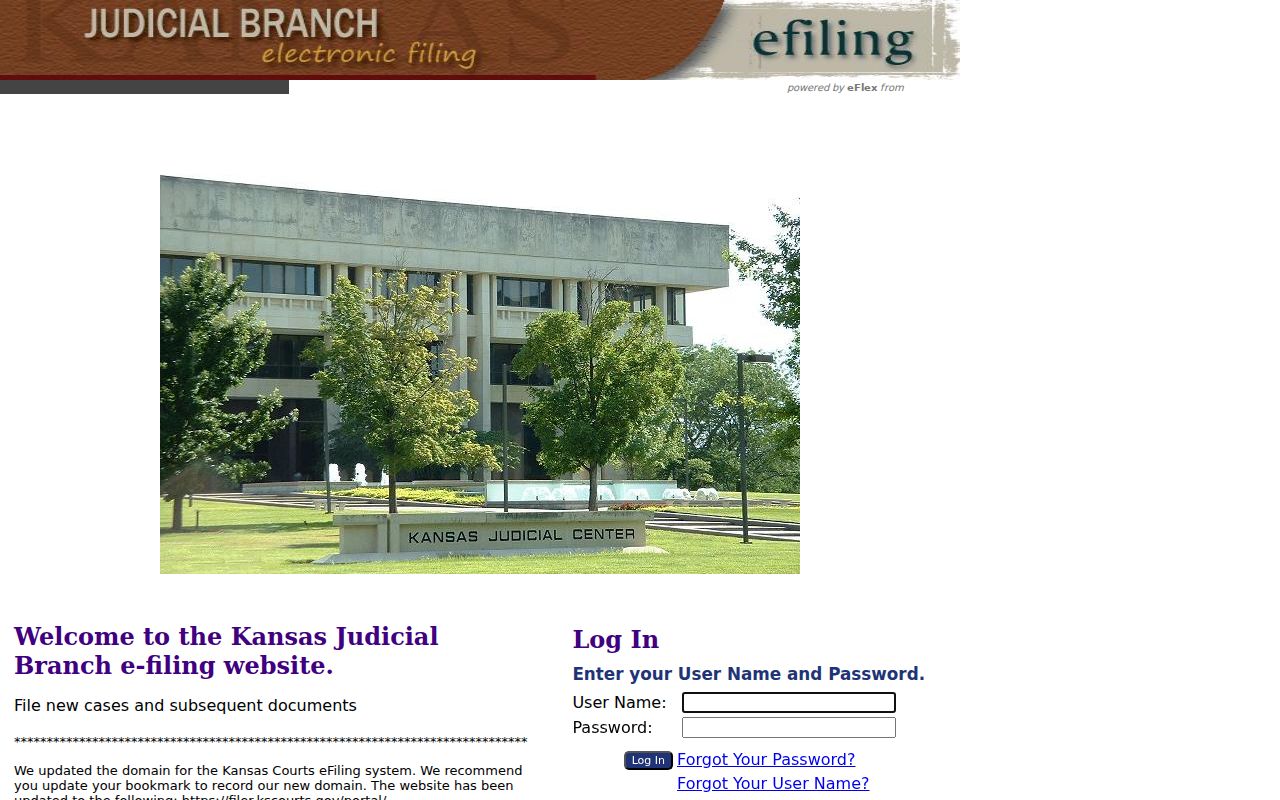
Keep the tools straight. CaseSearch serves public case information, eFlex serves authorized filing, and the clerk issues a certified court document. Logging into eFlex hoping for a public lookup just routes you into the wrong account process and returns no docket result.
Marshall Criminal Record Requests
CaseSearch may show a case header but not the paper you need. A charging document, bond order, journal entry, judgment, or sentence is best pulled at the public terminal. You can also request it from the clerk. The Marshall County Courthouse sits at 1201 Broadway, Marysville, Kansas 66508. Office #5 answers at 785-562-5301. The public-search window runs 8:30 a.m. to 4:30 p.m. on courthouse weekdays.
Mail works too. Send written requests to Marshall County District Court, P.O. Box 149, Marysville, KS 66508. The office also lists fax 785-562-2458 and Liberty.Priceobley@kscourts.gov for current submission guidance. Name the case number and the record title. Add the filing date if known, and whether you want a plain or certified copy. Plain copies run $0.50 for the first page. Each later page is $0.25 under the local FAQ. Staff time past 15 minutes costs $12 per hour in quarter-hour units, prepayment required. No separate certification fee appears online.
The Kansas court-record request form can back up a specific written request. The office must act as soon as possible. Under K.S.A. 45-218, action is due by the end of the third business day, or the office must give a reason for delay. Phone and email are fine for confirming procedure. Treat neither as a formal filing channel unless the clerk says so.
Access Rules for Criminal Dockets
Access comes in layers. Kansas Supreme Court Rule 22 puts eligible case information and event indices on the public portal or the courthouse terminal, and some public material may appear only at the terminal. Asking at the counter does not unseal anything. Juvenile, grand-jury, warrant, investigation, protection-order, expunged, and other protected categories stay excluded or restricted.
Public access has limits. K.S.A. 60-2617 requires the stated sealing and redaction process and a good-cause finding in ordinary civil or criminal matters. Rule 24 requires filers to protect listed personal identifiers. A redacted filing is not always sealed in full.
A blank result has several causes. The venue may be municipal. The number may be wrong, the file older or converted, or an access rule may apply. Confirm the court and case number, try the Marshall terminal for eligible public material, and ask Office #5 about a precise request. Never ask staff to bypass a restriction. For a fuller name-and-number workflow, use the Marshall County docket search.