
Marshall County Civil Docket Searches
Kansas CaseSearch is where public Marshall County District Court case information lives. Bring a case number if you can. It is the strongest key. Without one, type a party or business name and pick Marshall County under Filter by Location. Then narrow things down with the filing range, status, case type, or judicial officer. Case Type choices come straight from the live portal. Check the current menu instead of assuming an old civil label still exists. Whatever the search returns is only a starting point, never the certified civil file itself.
- Confirm that the caption or notice names Marshall County District Court, since municipal courts do not keep the county civil docket.
- Enter the full case number, or choose Party Name or Business Name and supply the best known name.
- Select Marshall County, then use a narrow filing range or civil case type if the first result list is broad.
- Complete the terms and human check, open the match, and verify caption, roles, filing date, judge, type, and status.
- Read the events in order and request the precise petition, order, judgment, or certified copy when its image is absent.
Marshall Civil Docket Counts
The FY2025 civil filing report runs from July 1, 2024 through June 30, 2025. Marshall County logged 414 civil filings in that stretch. The breakdown: 24 regular actions, 327 limited actions, and 63 domestic-relations matters. Most limited actions, 324 of them, were tagged contract, with three listed as other. Remember these are administrative buckets. They say nothing about any named case.
For the same fiscal year, the disposition report counts 531 civil dispositions: 47 regular, 448 limited, and 36 domestic-relations matters. Why can closures beat new filings? Older cases can wrap up during the window too. That total does not tell you a specific new filing got resolved. Only the Marshall County civil docket and the orders under it trace one case's path.
Civil Dockets: What They Show
A Marshall County civil case header lists the usual items. You get the caption, party roles, case number, filing date, assigned judge, case type, and status. The events index beneath it may show the petition or complaint, summons, service or return, answer, counterclaim, motions, hearing notices, mediation, orders, judgment, costs, and notice of appeal. Read dates carefully. An event date or filing time can differ from the hearing date itself. A public entry may also carry no downloadable image. The docket line is all you see.
| Case number | A newer number may follow MS-2025-CV-000001; this is a synthetic example, not a real record. |
|---|---|
| Caption and roles | The formal case title and parties identified as plaintiff, defendant, petitioner, or respondent. |
| Filings and service | Petition, complaint, answer, summons, return, waiver, or counterclaim entries recorded by the clerk. |
| Motions and settings | A request, a date set to hear it, and the judge's order appear as separate procedural events. |
| Judgment and later events | Dismissal, judgment, costs, garnishment, satisfaction, post-judgment motion, or appeal when public. |
A few cautions do heavy lifting here. "Filed" does not mean "served." A motion entry does not mean the motion was granted. And a judgment event is not a certified copy of the signed judgment. Those distinctions keep an events index from proving more than it does.
Marshall Small Claims Docket
Small claims run inside the unified Marshall County District Court, not a separate courthouse. Per the local district-court FAQ, the Clerk's Office hands out the forms. The published claim ceiling is $4,000. Once the claim is filed, the clerk sets a hearing date. The summons tells you its date and time. Skip the hearing and you risk a default judgment under the stated process.
| Small-claims item | Published amount |
|---|---|
| Docket fee for claim under $500 | $47.50 |
| Docket fee for claim from $500 through $4,000 | $67.50 |
| Witness fee for subpoena | $10 plus mileage |
Keep the paper types straight. A filing receipt is one record; a summons is another. The docket event, a default entry, and the signed judgment are three more. Ask Office #5 for the exact item you need. Confirm current fees before filing or paying, since the figures come from the published local FAQ.
What Cases Fill the Civil Docket
One district-court clerk covers several civil categories in Marshall County. Kansas adds no county court-at-law, justice court, or separate small-claims clerk here. To place a case correctly, read the case number, the caption, and the initiating paper; they show the right category.
- Regular actions, including contract, property, tort, and other civil claims.
- Limited actions, which form a distinct court-reporting category and include many contract matters.
- Small claims within the local published limit and filing process.
- Domestic relations, including marital status, parentage, and some protection matters.
- Probate, guardianship, conservatorship, mental-health, and related proceedings with category-specific access rules.
City municipal courts take ordinance and municipal traffic cases. Living inside city limits does not make them a second route for a contract, property, or small-claims suit. Some sensitive civil categories deserve extra care too, since they are not ordinary open contract files.
Marshall Events and Signed Orders
An events index tells you when an item hit the record. It also shows how the clerk labeled it. The document underneath tells you what was alleged, requested, or ordered. In a Marshall County civil docket, watch four labels closely: "motion filed," "motion set," "motion denied," and "motion granted." Each one answers a different question.
Watch for life after closure. A case header marked closed can still show later activity. It may involve costs, execution, satisfaction, garnishment, appeal, or another post-judgment step.
- Service or return
- The record of delivery efforts or completion; filing the complaint alone does not prove service.
- Notice of setting
- A dated notice of a hearing. A later continuance or reset can replace that date.
- Default judgment
- A judgment entered after a required response or appearance was not made, subject to court rules.
- Disposition
- An event that resolves a case or claim, such as dismissal or judgment.
- Satisfaction
- A later event tied to a judgment; the docket label should be checked against the filed document.
Need a result with official authentication? Request the named judgment or order as a certified copy. A portal printout is not automatically certified, and the clerk cannot tell a requester what the judgment means.
Hearings on the Civil Docket
Check the setting before you rely on it. A civil docket entry might cover scheduling, a motion, pretrial work, mediation, default, or trial. It is not automatically a trial date. The newest notice or order controls the date, time, courtroom, judge, and event type. Older settings can linger in the history after a continuance. The most recent entry governs unless the court says otherwise.
Small-claims summonses carry hearing details the clerk supplies. Regular and limited civil matters may instead follow a scheduling order with several deadlines. Something look off? Call the Marshall County District Court at 785-562-5301. The local FAQ also tells jurors and trial participants to call after 5:30 p.m. the day before trial. That call yields the answering-machine confirmation. It supplements the docket; it never replaces a court order.
Read motion, notice, and order entries on their own terms. A motion is a request, not a ruling. For the full date-confirmation route, see the site's Marshall County court schedule resource.
Marshall Civil Docket Counter
The district clerk sits at Office #5. The office is on the main floor of the Marshall County Courthouse, 1201 Broadway, Marysville, Kansas 66508. That counter handles civil, limited civil, small claims, divorce, parentage, protection orders, probate, and related case files. The clerk's official page explains. A public computer there supports case searching. Staff run record searches from 8:30 a.m. through 4:30 p.m. on weekdays.
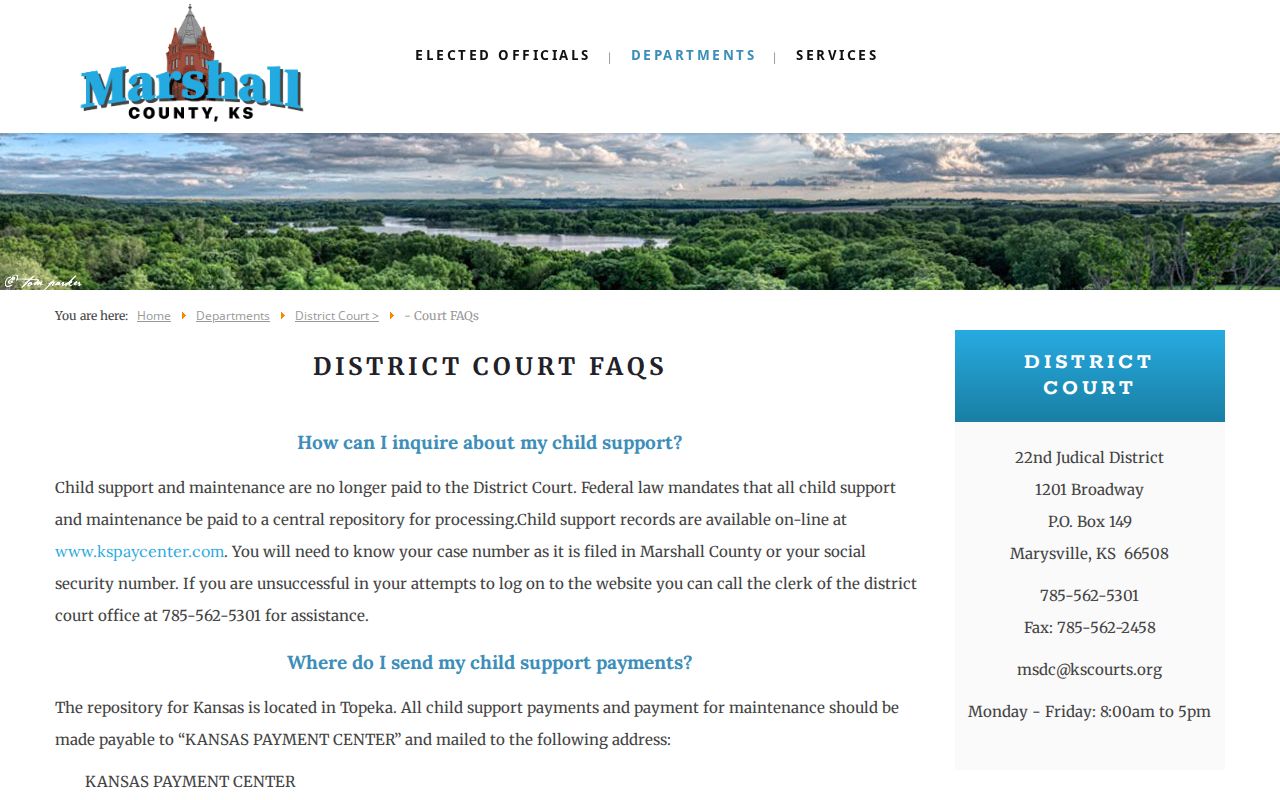
The local FAQ spells out the public computer, the written request process, and the copy fees. It gathers them in one place.
The screen makes one distinction clear. Free case information online, a terminal review, and a clerk-produced copy are three separate layers of access. Bring the exact case number, party names, filing year, and document title. That lets the clerk find the file fast. Before the total is calculated, ask whether the copy should be plain, certified, or exemplified.
Marshall Civil Copy Requests
Copies take a written request under the local FAQ. Mail it to Marshall County District Court, P.O. Box 149, Marysville, KS 66508. Current instructions are published at 785-562-5301, fax 785-562-2458, and Liberty.Priceobley@kscourts.gov. A strong request lists the case number, caption, exact pleading or order, filing date if known, delivery choice, and whether certification is needed. The more precise it is, the faster the clerk can act.
| Copy service | Local published term |
|---|---|
| First plain paper page | $0.50 |
| Each additional plain page | $0.25 |
| Staff time beyond first 15 minutes | $12 per hour, billed in 15-minute units |
| Certified or exemplified copy | No separate amount published; confirm with Office #5 |
Prepay for the published staff and copy work. The Kansas court-record request form covers court selection, requester contact, and delivery choice. It also provides a description area and certification. Under K.S.A. 45-218, the office must act as soon as possible and by the end of the third business day, or give a written reason for delay. Phone, fax, and email work well for confirming the submission route. One caution applies. Never assume an email counts as an accepted court filing.
Who Can See Civil Dockets
Kansas Supreme Court Rule 22 splits public electronic access between the web portal and courthouse terminals. A public case can be hidden from remote display yet still sit at the terminal. Sealed or nonpublic material appears in neither channel. Domestic-relations documents, protection matters, probate, guardianship, conservatorship, mental-health records, and other listed categories face stronger limits. An ordinary contract case does not.
A missing result is not a disclosure ruling. K.S.A. 45-221 addresses exemptions and separation of open portions. K.S.A. 60-2617 supplies the sealing and redaction process for ordinary civil and criminal matters.
No civil record showing up? Confirm the venue, the number, and the case type first. Then check the Marshall terminal for eligible public material. Ask Office #5 whether a focused written request fits. A notice of appeal may point to the separate Kansas appellate portal. The district clerk keeps the trial-level file, though. Never request protected party data to get around the governing rule.